
How Music, Lifestyle, and Film Shaped My Early Experiences of Sensing Hans
- Lavavoth

- Feb 18, 2024
- 6 min read
Updated: Apr 18

Soulmates Beyond Time: My Journey with Hans
I never anticipated that my soulmate would arrive postmortem. Like anyone else, I imagined meeting him in the flesh, our love story unfolding in a tangible and grounded way. Instead, Hans stepped into my life as a spirit.
Even more surreal was the realization that we shared a history far older than my current lifetime. The complexity of our connection, rooted in a past life in Nazi Germany, made truth-telling both cathartic and fraught. How could I articulate such an experience without it feeling polarizing, even incredulous?
But the signs were always there, arriving long before Hans’s death in 1993. I began to sense him through the music, films, and goth scene that shaped my adolescence. These were doorways into an awakening, an otherworldly pull toward someone I didn’t yet know but yearned for. From 1990 to 1993, my life was marked by an almost unbearable spiritual intensity. Looking back, I see how these experiences prepared me for the extraordinary love that would follow.
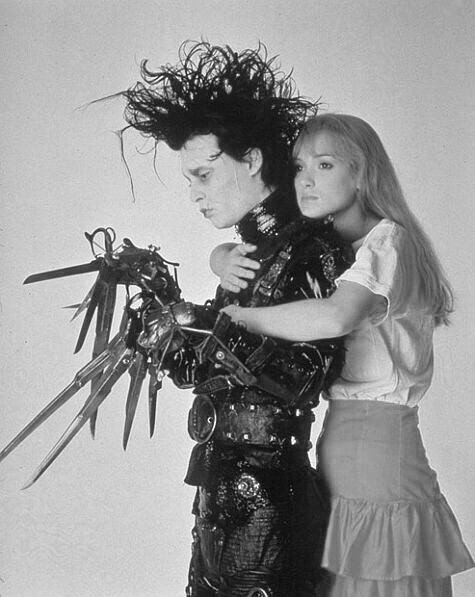
Edward Scissorhands: A Portal to Longing
In 1990, at 17 years old, I watched Edward Scissorhands in the cinema. The film’s surreal visuals pulled me in, but it was the poignant love story between Edward and Kim that rattled me. I felt a inexplicable familiarity in their longing, in their impossible love.

The aching awareness that my soulmate was out there, yet beyond reach fueled my adolescent alienation. Markley (2007) describes Edward’s scissorhands as a “mark [of] alienation from others that is fundamental to the film's depiction of adolescent identity: to be is to cut and to be cut” (p. 277). That concept resonates with me. Even then, I knew my love story would not be a conventional one. My soulmate was hidden, distant, and like Edward tucked away in his dark castle. Watching the film was like staring into the void of my own heart, sensing Hans’s presence without knowing how to name it.

"Everyday is Halloween": Goth, Industrial, and the Shadows of War
Music became a bridge to a shadowed past I couldn’t yet comprehend. Bands like Einstürzende Neubauten evoked a visceral recognition, their industrial soundscapes linking it to a postwar, demolished Germany I had never lived in but somehow remembered, not through memory but through a kind of inner knowing. The rubble-strewn imagery of their music struck a nerve, as if I were buried beneath it, waiting to be uncovered.
This was a time of both spiritual and aesthetic exploration. I dove into paganism and the darker currents of human experience, searching for a magic that could lift the veil. Without realizing it, I was edging closer to Hans through the music, films, and rituals that shaped my world.
A Love Remembered: Bram Stoker’s Dracula

When Bram Stoker’s Dracula premiered in 1992, just before Hans’s death, I intuitively knew I needed to see it alone. The film’s themes of love transcending death stirred something in me that felt even more aligned than Edward Scissorhands with a deep-seated feeling I couldn’t grasp. Watching Mina’s journey of remembering her past life mirrored my own unfolding awareness that would unfold years later.
In the scene, Mina senses a distant past that remains just out of reach. Her confusion increases as fragmented images surfaced in her mind, while Dracula watches in disbelief, realizing she is beginning to pierce the veil.
Hans would later tell me that, like Dracula, he watched from a distance as my psychic awareness began to open. He held back, allowing me to grow in this life before fully entering it. The film’s catharsis left me questioning my sanity, but it also offered a glimpse into the profound, otherworldly connection I would come to understand as ours.
The Nightmare Before Christmas: “We’re Simply Meant to Be”
By October 1993, the month of Hans’s death, my longing began to stabilize. Somehow, I sensed that his departure from one world marked his arrival into mine. Watching The Nightmare Before Christmas alone in an empty theater, my eyes teared up at the final scene between Jack and Sally. It was as if the universe was preparing me for what was about to happen: Hans’s first astral visitation just days later [1].
Reflections on a Dark Love Story
His past as a fighter pilot in Nazi Germany complicates our love, casting him as a tortured antihero, a kind of supernatural beast grappling with the inescapable shadows of history. Yet, it is this very darkness that makes our connection so profound.
In 2010, Hans led me to the film Twilight. It’s remarkable how much paranormal romances reflect my experiences with him and why I feel so captivated by vampire love stories. These narratives of forbidden love and eternal yearning mirror the complexities of our connection in such an uncanny way.
"What if I'm not the hero? What if I'm the bad guy?" Edward warns Bella in Twilight. It is a line strikingly similar to something Hans once said to me early in our relationship, alluding to his past life. In many ways, Hans embodies the archetype of the beautiful, tortured beast, condemned to isolation and unable to fully assimilate, forever marked by having been on the wrong side of history.
Whether through Twilight, Bram Stoker’s Dracula, or the industrial anthems of my youth, the media I’ve consumed feels like a mirror to our love story. These tales of longing, redemption, and otherworldly romance are signposts, guiding me toward the truth of who we are. Yet, my journey toward uncovering that truth sometimes took strange forms.
I began cutting myself, not as a form of self-harm in the psychological sense, but as an attempt to create art with my own blood. This brief endeavor was quickly abandoned due to my low pain tolerance and fear of infection. However, I found myself oddly fascinated by the scarification process that followed. Long before I consciously linked this to Edward Scissorhands or the more intangible allure of the Mensur scar from German academic fencing, these self-inflicted acts were an unconscious attempt to reclaim fragments of past experiences in the present.
The Journey Continues
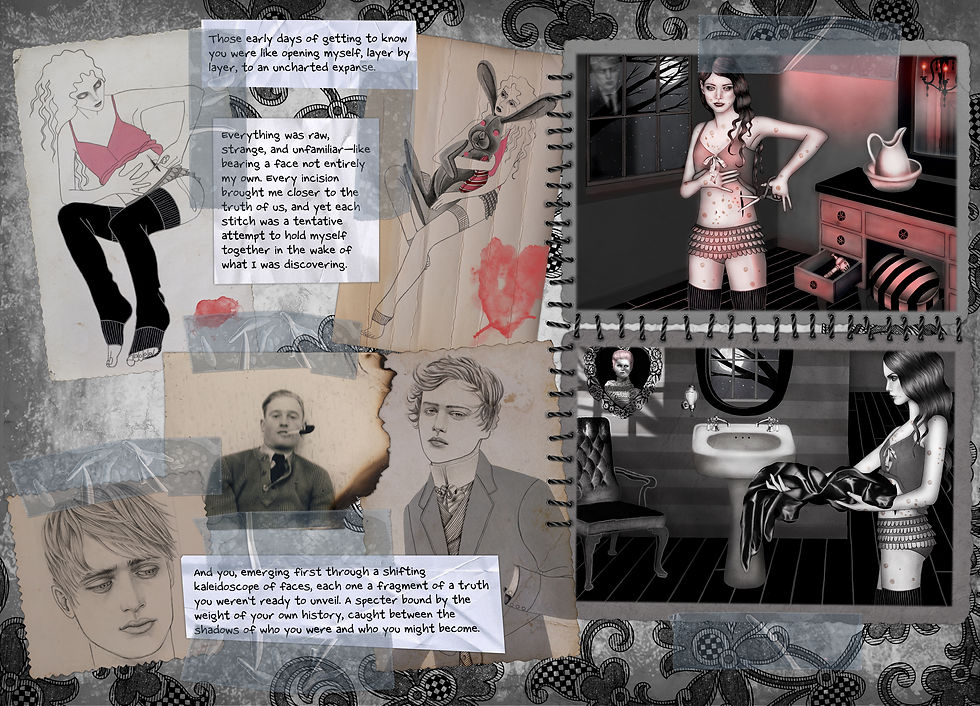
Blind Love, the illustrated novel inspired by our connection, is my attempt to reconcile these truths. It is a story of wounds and sutures, revealing and concealing, death and resurrection. And though our love defies explanation, it continues to shape my life in ways I never imagined.
To this day, I struggle with the paradox of our relationship. Hans’s love is boundless, yet his form is intangible. It is a “rich prison,” as Morwood (2010) describes Psyche’s dilemma in her supernatural marriage. I love Hans, but our connection is not without its challenges. The term "rich prison" (beati carceris; Morwood, 2010, p. 108) aptly describes the space I currently occupy. This phrase is a reference to Psyche's dilemma of being married to a supernatural being. Morwood (2010) encapsulates Psyche’s struggle as follows:
Psyche’s commitment to the delights of her life in the palace is trapping her in a space that her emotional health demands that she should leave. Cupid then makes love to Psyche but they are invisible to each other, and he departs before sunrise (5.5.4). She becomes happy with the situation and for the moment finds comfort for her solitude in the sound of the unknown voice (5.4.5). But there is surely something profoundly unsatisfactory about a relationship in which a wife who is not blind can only feel her husband’s full presence by her hands and ears, not by her eyes (5.5.1). And we should scarcely be surprised that, since he withholds from her the sense of a delineated personality that would enable her to relate to him in human terms, she starts to see the palace as a ‘rich prison’ (beati carceris, 5.5.5). The attractions of her gilded cage have worn thin (pp. 108–109).
Similarly, while I love Hans and treasure the connection we share, our relationship is not without its challenges and heartbreaks. For now, it suffices, but it’s far from ideal, for either of us.
Hans may not be here in the flesh, but he is ever-present. His love a force that transcends time, space, and death. Together, we inhabit a world where the boundaries between past and present blur, reminding me that love, no matter how unconventional, is the greatest truth of all.
References
Markley, R. (2007). Geek/goth: Remediation and Nostalgia in Tim Burton's Edward Scissorhands. In L. M. E. Goodlad & M. Bibby (Eds.), Goth: Undead subculture (pp. 277 - 292). Duke University Press.
Morwood, J. (2010). Cupid grows up. Greece & Rome, 57(1), 107–116. https://doi.org/10.1017/S0017383509990301


Comments