
Ewiger Wald: The Roots of Ecofascism and My Love for the Real Eternal (Black) Forest

Updated: May 19

Waldkindergärten
For many Germans, the forest offers refuge from the pressures of contemporary life. Over time, it has become common for parents to enroll their children in Waldkindergärten, forest nurseries where education unfolds entirely outdoors. In these unconventional classrooms, children explore the wilderness through direct experience, guided by spontaneous, science-informed questions posed to their instructors. This immersive learning fosters not only intellectual curiosity but also a spiritual connection to nature. By engaging all their senses and drawing on their innate creativity, children learn to commune with the natural world, cultivating a sense of balance and ecological responsibility that stays with them long after.
The Hidden Life of Trees
The forest is so deeply woven into the German experience that forester Peter Wohlleben wrote an entire book about the social lives of trees and their emotional capacity. After reading a New York Times article about his work (and later buying the book), I remember thinking, This is yet another confirmation that I’ve lived a past life in Germany. I’ve always felt a profound kinship with the woods. When I hike, I speak to the trees, sing to them, run my hands along their trunks, and gently touch their leaves. It’s no coincidence that my home borders a forest [1]. I need trees around me. More often than not, I prefer the quiet presence of these rooted beings to the company of people.
A Revelation through Google Earth
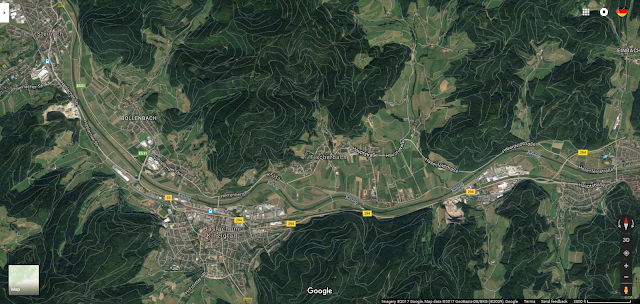
Given Germany’s longstanding bond with the forest, I had always assumed its woodlands remained vast and thriving. But a recent exploration on Google Earth quickly dismantled that belief. I was shocked to see how much of the country’s legendary forests had been depleted. In the images below, the dark green areas show what remains of the Black Forest. The second image offers a closer look, revealing how farmland and urban development have gradually carved into what was once an uninterrupted stretch of wilderness.

But it wasn’t always this way.
Long before the Roman Empire pushed its borders into the region, much of what is now Germany was dense, uninterrupted woodland. Today, that ancient forested terrain has been largely replaced by farmland and small towns, with only scattered remnants of woodland still marking the landscape.
A Fascist Deforestation Effort
So what happened? When were the forests erased? Was it a sudden event, or a slow progression tied to population growth? In truth, the answer draws from all three, and at the center of its most devastating chapter stands the Nazi regime.
Known for its ruthless efficiency and obsession with secrecy, the regime implemented “solutions” that were both systematic and obscured. As militarization accelerated deforestation, the Nazis offered no explanation. Silence masked destruction.
On the surface, however, the propaganda painted a very different picture. National Socialist media flooded the public sphere with imagery romanticizing Germany’s deep-rooted connection to the forest. The 1936 film Ewiger Wald (The Eternal Forest) idealized this relationship, portraying a sacred symbiosis between the German people and the woods. The forest, much like the so-called eternal people, the Volksgemeinschaft, was portrayed as something mythic, pure, and worth defending. It became a symbolic homeland, one that aligned perfectly with the regime’s racial and nationalistic ideology.
Yet beneath this greenwashed narrative, the truth was starkly different. Despite the regime’s adoption of certain “ecological components of Nazism” (Gerhard, 2015, p.114), which likened the forest’s spirit to that of the people, Germany’s ancient woodlands were being rapidly cleared to make way for industry, infrastructure, and war.
In the decades since, Germany’s forests have regained approximately one million hectares, making the country one of the most "densely wooded countries in Europe" today. Still, with a population exceeding 81 million and urban expansion continuing, the once-endless forests are now reduced to a fractured system of small, scattered woodlands, remnants of a mythic past on an inevitable track toward extinction.
Vermont Forests
Comparing the forests of Vermont to those of Germany reveals striking differences. Although Vermont is geographically far smaller than Germany, the forests throughout the Green Mountain State and the surrounding regions remain dense, lush, and largely uninterrupted. Below are satellite views of Vermont shown at the same proportions as the maps of Germany above, 50 miles and 2,000 feet respectively. Notice the stark contrast between the two landscapes.


Comparing these differences between Vermont, my adopted home, and the fractured landscape of Germany to which my soul remains anchored is heartrending. Germany is a country marked by the irreversible consequences of its own history, and its forests increasingly resemble something receding into folklore rather than living expanses of wilderness.
My Spirit in This Ancient Ground
Whenever I meditate or astral travel, I inevitably find myself in the Black Forest, connecting with faeries and otherworldly beings. I see myself lounging on moss or sunning nude on a boulder beside a lake while, in the distance, the German Alps emerge through clusters of clouds. Whenever I go there, I become the keeper of the forest, the protector of trees, a warrior devoted to the preservation of nature. When I take my last breath in this life and the ether reclaims me into the eternal forest of my cosmic heart, I will hold my focus on the Black Forest and leave part of my spirit within its ancient ground.
Notes
[1] I actually now own a log cabin on nearly 25 acres of forest in the Northeast Kingdom, Vermont.

Comments