
A Marathon through the Woods: Back-to-Back Dreams

Updated: Jun 10
Introduction: The Living Ghost
As I'm about to undergo surgery again as mentioned here (along with additional updates to the post), my dreams and restlessness have kicked into overdrive. If you're familiar with the material published throughout this website, you already know that I'm not only a believer in the strange and unusual, but an experiencer of it as well. While I believe dreams can sometimes reflect aspects of our lived experience that require attention or resolution, I also believe we possess the capacity to travel elsewhere and to each other through altered states of consciousness. Although I can't prove that the dream accounts below represent any form of astral communication or visitation, I was grateful to experience them in the days leading up to surgery.
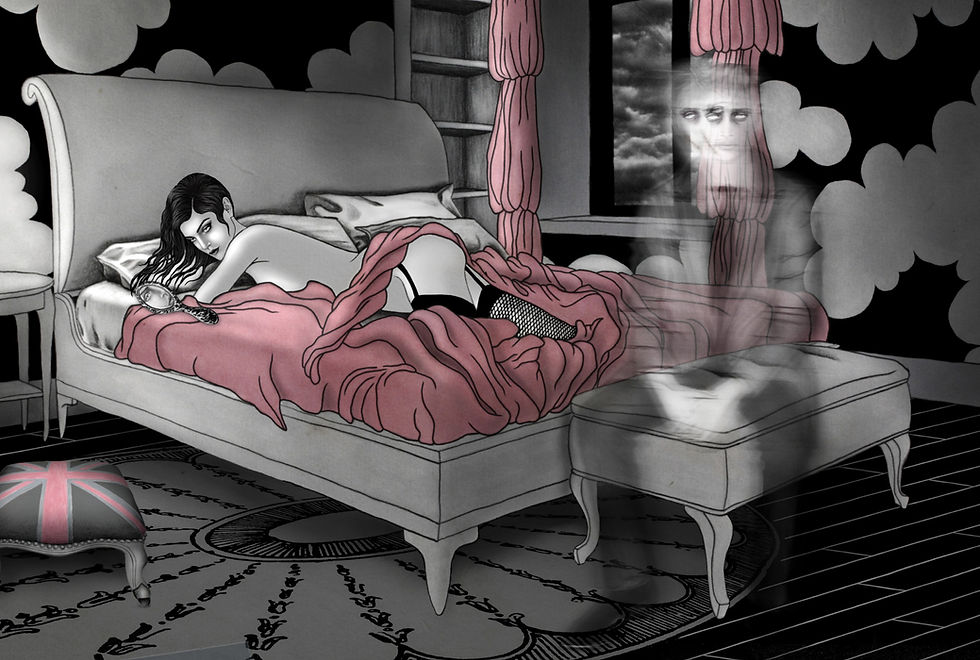
The man hiding in the shadows of these dreams behaves more like a ghost than Hans. He has spent years appearing through fragments, indirect signals, and long absences rather than through direct engagement. Because he is alive, the idea of intentionally summoning his presence through ritual, séance, or any other means isn't something I pursue. Nor do I cast spells, manipulate outcomes, or interfere with another person's free will. How he chooses to navigate this reality, and whether he chooses to approach at all, remains entirely his decision.
Dream Accounts
Dream Account 05.28.26
A man I knew long ago arrives in my dream with his usual cloak-and-dagger manner. He isn't physically present. Instead, his name appears written in pencil on a weathered, poster-sized sheet of paper. There are timestamps and the promise of something unfinished. The atmosphere is dark, particularly in the places where he lingers. He avoids direct contact, reluctant to reveal himself.
At times, the experience feels like I'm watching a strange, plotless film unfold before me as I search for clues and answers, wondering why he doesn't simply step out of the shadows. I wake up wondering if he pulled me out of my body and took me to the place where he remains stuck.
Dream Account 05.29.26
The same man from the previous dream is now fully present. Gone are the fragments, clues, and obscured traces. He stands before me displaying his brightly colored plumage of conquest, yet he remains careful, as he always has, not to fall prey to the emotions that move beneath his composed exterior.
Suddenly, we're walking together along a forest path. He tells me how much he loves running marathons in the woods. The statement catches me off guard because I have no recollection of ever knowing this detail about him.
When I tell him that my property contains many downed trees, his eyes lower in disappointment. Yet he doesn't leave. He remains beside me and our bond deepens despite my admission of a landscape that's become difficult to navigate alone, without the help of another living person.
I wake laughing, happy that he'd stepped forward and finally revealed himself to me, even if only through his dream presence.
A brook, fed by the pond across my property, runs east to west through the landscape before bending north along the eastern boundary and opening into Class II wetlands. The sound accompanying this video is the brook itself, not the music.
Analyzing the Dreams
What strikes me most about these dreams is the movement from absence to presence.
In the first dream, the man never fully appears. There's only his name, written in pencil on a large weathered paper, accompanied by timestamps and fragments that evoke an ephemeral manifestation suspended between appearance and disappearance. He exists as a remnant rather than a person. The dream unfolds like a mystery in which I spend most of my time searching for clues while the central figure remains hidden. His presence is felt, yet he refuses embodiment.
By the second dream, this dynamic has shifted. The fragments have coalesced into human form. He has stepped out of the shadows and into full view.
The forest imagery is equally compelling. Forests rarely offer straight trails. Their paths branch, narrow, and vanish from sight, requiring trust in instinct rather than certainty. If forests symbolize dreaming, precarious boundaries, healing, the unconscious, or a place where anything is possible (Ronnberg & Martin, 2010), then running a marathon through them becomes a prolonged engagement with inner terrain, one that values exploration over arrival. In The Book of Symbols, Ronnberg and Martin (2010) describe the forest in this way:
The forest, with its exotic forces, is "outside" the inhabited precinct of consciousness... The boundaries are often depicted as tenuous; many tales begin with the protagonist living "at the edge of the forest," just as, inevitably, the worlds of typical and archetypal impinge upon each other. An unusual presence comes out of the forest (p. 118).
Unlike a marathon on a road, which follows a visible route through a managed environment, a marathon in the woods requires a relationship with the landscape itself. The terrain shapes the journey. Fallen trees, changing conditions, and unexpected obstacles demand adaptation rather than control. In this sense, the runner isn't merely moving through the forest because the forest itself is an active participant in the experience.
An SNL short because life occasionally demands less analysis and more laughter.
Viewed through this lens, the downed trees take on additional significance. Fallen trees can represent obstacles, old wounds, accumulated grief, responsibilities and burdens, or the aftermath of storms that have passed through one's life. They complicate movement through the landscape. They require detours. They transform what might otherwise be an open path into something far more demanding. Trees can also represent an "intense inner life and development that follows its own laws and can reveal the 'evergreen' within the individual" (Ronnberg & Martin, 2010, p. 130).
When I tell him that my property contains many downed trees, I am, in a sense, revealing the condition of my current inner landscape. His disappointment doesn't strike me as judgment. Instead, it's a recognition. The journey is harder than either of us would like it to be. Yet despite this realization, he stays beside me. The dream ends with companionship, not necessarily a passionate one, though the tension is there, but one that is deep and unfettered.
Taken together, the dreams suggest a movement from distance toward connection, from symbolic ethereality toward direct encounter/manifestation, the ghost resurrecting into something tangible. It transforms from searching for someone hidden in the shadows to walking beside them through a landscape that neither of us pretends is easy to navigate.
Reference
Ronnberg, A. & Martin, K. (Eds.). (2010). The book of symbols: Reflections on archetypal images. TASCHEN.
Comments